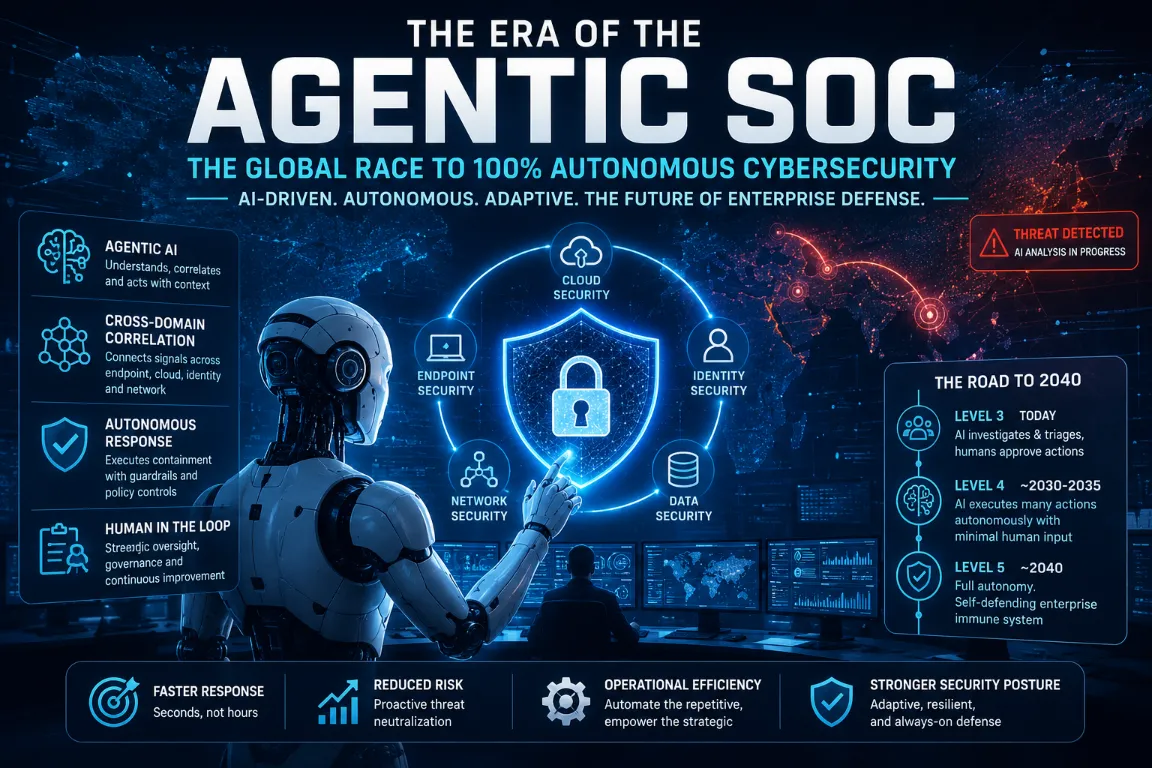
The Era of the Agentic SOC: The Global Race to 100% Autonomous Cybersecurity
Enterprise cybersecurity architectures have reached a critical breaking point. With adversarial breakout times shrinking to mere seconds and AI-assisted cyber attacks operating at machine speed, traditional Security Operations Centers (SOCs) relying on human analysts can no longer keep pace. To combat these escalating threats, the cybersecurity landscape is undergoing a massive paradigm shift: moving away from static, playbook-driven automation toward agentic artificial intelligence and fully autonomous cybersecurity.
But how close are large organizations to achieving a truly autonomous, self-defending enterprise?
Beyond SOAR Playbooks: The Rise of Bounded Autonomy
For the past decade, SOC automation relied heavily on Security Orchestration, Automation, and Response (SOAR) platforms. While these tools excel at executing deterministic, repetitive tasks, they fail to adapt to novel and sophisticated threats.
Agentic AI changes this dynamic entirely. Instead of following rigid scripts, AI-driven cybersecurity agents can dynamically interpret complex alerts, correlate cross-domain telemetry (such as connecting an endpoint anomaly to a cloud identity provider login), and autonomously formulate automated threat response plans.
However, despite marketing claims of "100% AI automation," the current engineering reality is defined by bounded autonomy. Because Large Language Models (LLMs) carry inherent risks of hallucination, mature enterprise platforms wrap these cognitive engines in strict, deterministic shells. The AI evaluates the data and generates a verdict, but high-risk containment actions—like isolating a cloud server or rewriting firewall rules—are governed by strict role-based access controls and auditable execution paths to ensure enterprise compliance.
The Market Contenders: Mega-Caps vs. Agile AI Disruptors
Enterprise Giants and Unified Platforms
Mega-cap innovators like Palo Alto Networks, CrowdStrike, Microsoft, and Google Cloud are leveraging their immense telemetry networks to build autonomous capabilities directly into their core XDR and SIEM platforms. These systems are designed to not just react to threats, but to proactively forecast lateral movement and apply predictive shielding before an exploit executes. Furthermore, hardware leaders like NVIDIA and IBM are providing the essential GPU-accelerated microservices required to run intensive SecOps AI workloads at the network edge.
Agile Agentic AI Startups
On the other side are agile disruptors building platforms entirely from the ground up for agentic execution. Startups specializing in hyperautomation and agent-vs-agent warfare utilize multi-agent swarms that simultaneously investigate alerts across cloud, network, and endpoint domains. This parallel processing compresses investigation times from hours to minutes, drastically reducing manual Tier 1 SOC analyst toil.
The Road to 2040: The Autonomous Cybersecurity Maturity Model
We are currently in a transitional phase of enterprise security architecture. Most advanced enterprise platforms operate at Level 3 of the Autonomous Cybersecurity Maturity Model—where AI agents autonomously investigate and triage alerts, but human security analysts remain "in the loop" to authorize final containment actions.
Over the next decade, as contextual AI accuracy nears perfection, organizations will systematically cede execution authority to these autonomous entities. By 2035, we expect to see mainstream adoption of autonomous defensive patching within CI/CD pipelines and real-time network topology shifts to isolate threats.
Ultimately, by 2040, the enterprise security perimeter will evolve into an ambient, self-governing immune system capable of full Level 5 autonomy—moving human defenders out of daily operational roles and entirely into strategic risk governance and threat modeling.